

Abstract
CopyQuad skips the hardest step in video-to-robot imitation: estimating depth. A side-view camera of a walking or trotting animal already shows almost everything a robot's retargeter needs, fore-aft motion and height. It hides only the sideways axis across the body, the one a depth model is normally called in to recover. CopyQuad doesn't recover it. It pins that axis to the robot's own stance width and measures what that costs, instead of assuming a depth model would do better.
How CopyQuad works
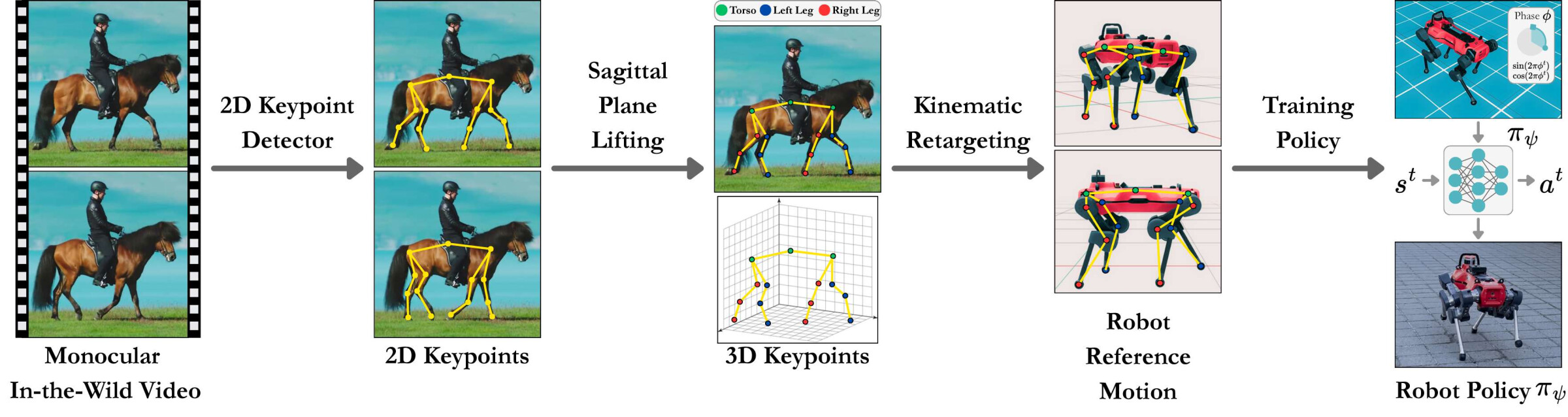
A side-view camera is a weak-perspective projection of the sagittal plane: it reads fore-aft position and height cleanly, and hides the lateral axis across the animal's body almost entirely. Prior pipelines add a lifting stage, a monocular depth model or a per-clip 3D reconstruction, to recover that missing axis. CopyQuad skips it. A quadruped's lateral limb motion is small to begin with, so CopyQuad just pins that coordinate to the robot's own stance width and lets a fixed analytic pipeline do the rest.
Sagittal lifting, pinned laterally
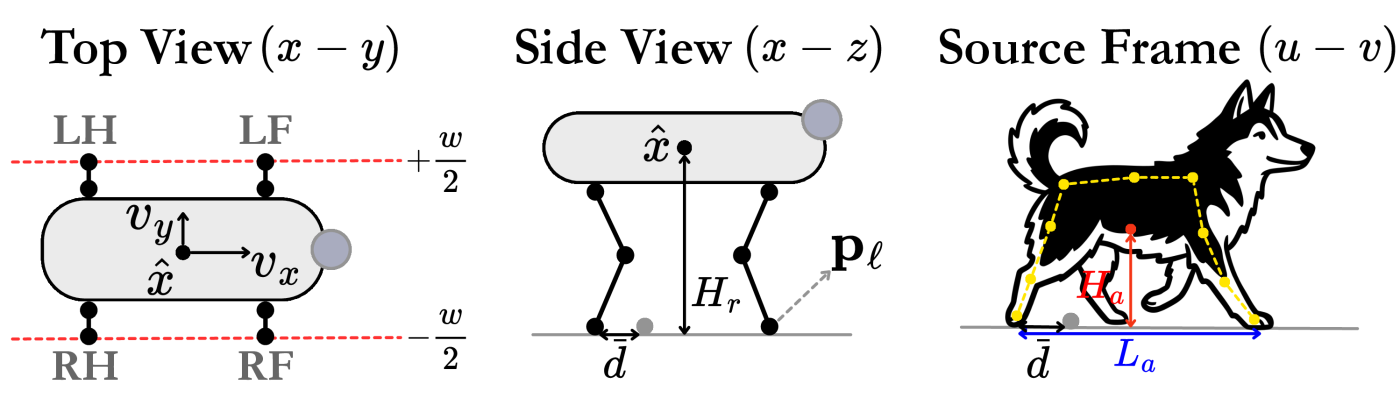
pₖ = (sₓuₖ, y_nom, −s_z vₖ)Each 2D keypoint gives fore-aft and vertical pixel position. The lateral coordinate is set to a fixed value read off the robot's own morphology, ±half its stance width, rather than estimated. Every foot target then lies on a track the robot can already reach, on every clip, with no per-clip repair.
Kinematic retargeting & root recovery
v̂ = d̄ × f̂Damped least-squares IK turns the lifted keypoints into joint angles, holding the base fixed. Forward translation isn't captured by IK alone, so it's recovered separately from each foot's fore-aft sweep and the gait's footfall frequency, giving a straight-line base trajectory the policy can track.
Phase-indexed imitation policy
rₜ = wⱼrⱼ + w_f r_f + wᵣrᵣ − wₐrₐOne DeepMimic-style policy per behavior tracks the reference at its current phase, rewarded for matching joint angles, foot positions and root motion while penalizing jerky actions. The only thing that changes between behaviors is three reward scalars, picked from one shared grid.
Results
Five behaviors, in simulation and on hardware
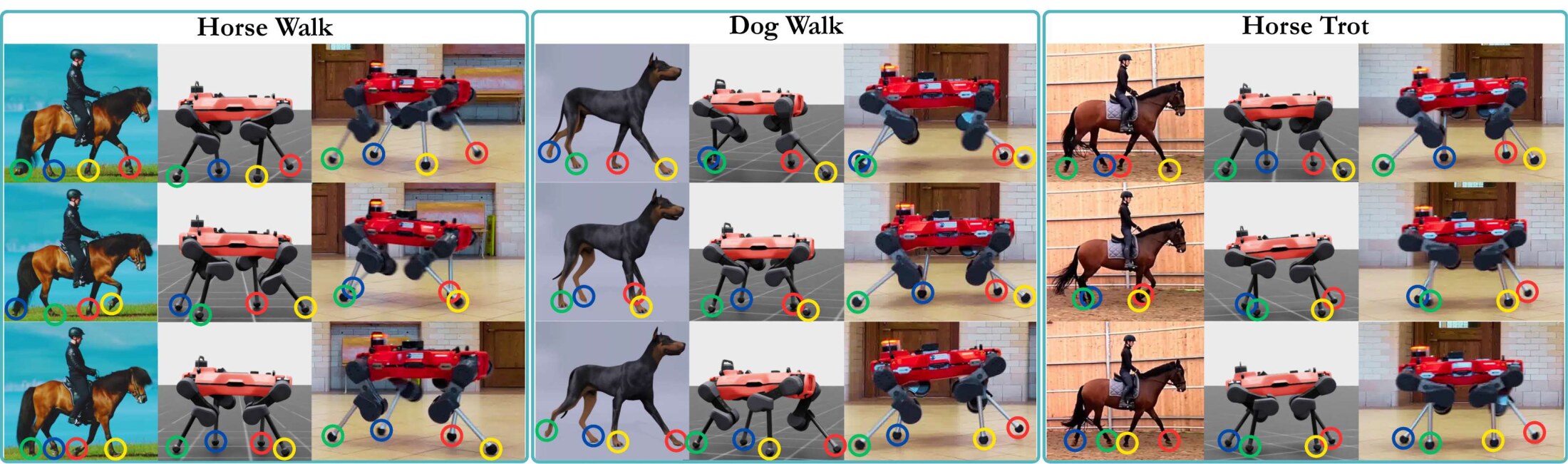
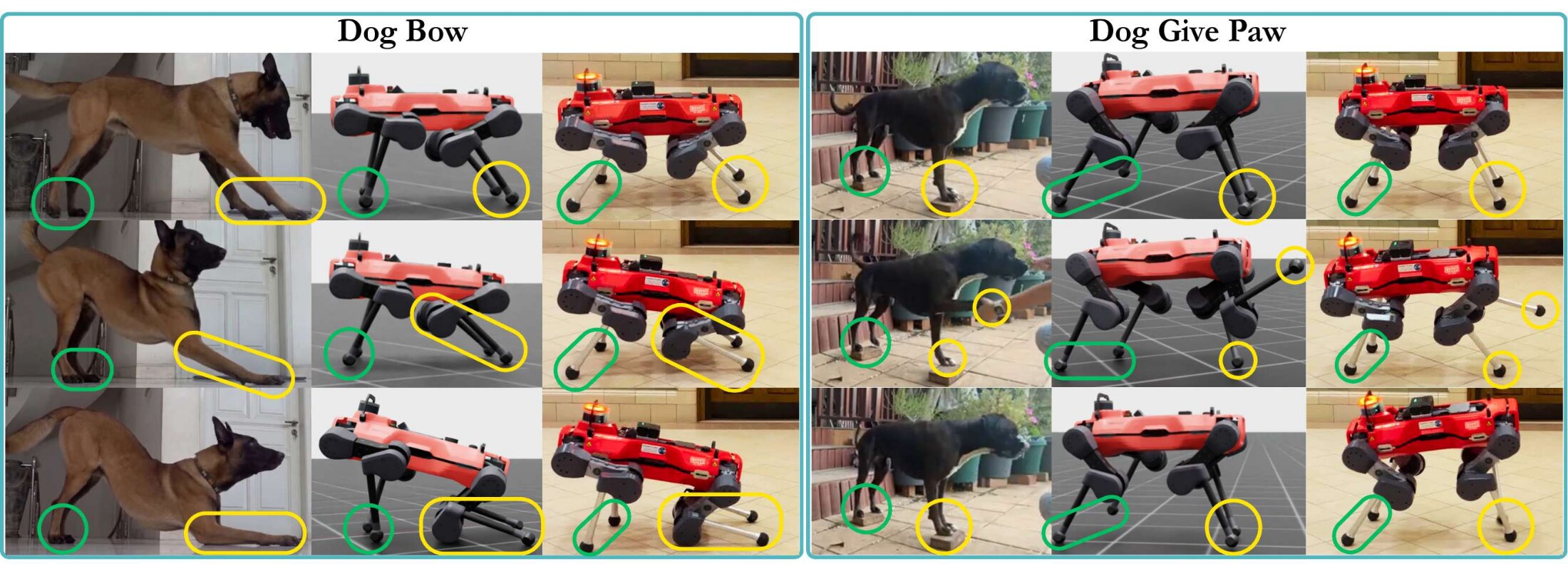
Using one pipeline and one reward structure, CopyQuad learns a dog walk, a horse walk, a horse trot, a dog bow and a dog give-paw, each from a single clip, and transfers every one of them to a physical ANYmal-D zero-shot. Agreement with the reference is coarse by design: the per-joint error concentrates in the sagittal hip and knee, the joints actually driven from the image, and not in the pinned hip abduction. The claim is gait-structure transfer, not pose-level fidelity, and the keyframes below show that structure surviving the jump from video to simulation to hardware intact.
| Behavior | Dog walk | Horse walk | Horse trot | Dog bow | Dog give-paw |
|---|---|---|---|---|---|
| clip fps / length (s) | |||||
| Source clip | 30 / 21.4 | 25 / 21 | 30 / 36 | 50 / 7 | 30 / 8 |
| Sim: ep (cm) ↓ | 13.7±1.8 | 15.0±2.6 | 15.5±2.0 | 7.4±0.4 | 11.8±6.8 |
| Sim: survival (s, cap 20) | 19.9±0.2 | 19.5±0.7 | 19.6±0.5 | 20.0±0.0 | 15.1±2.9 |
| Hardware: eq (deg) ↓ | 16.8±1.1 | 15.4±1.3 | 13.5±1.0 | 5.9±0.5 | 9.6±2.8 |
| Hardware: ep (cm) ↓ | 15.9±1.4 | 17.1±1.7 | 17.8±1.5 | 8.6±0.6 | 13.1±3.9 |
| Hardware: survival (s, cap 20) | 20.0±0.0 | 20.0±0.0 | 20.0±0.0 | 20.0±0.0 | 19.0±2.0 |
A do-nothing floor, holding the nominal stance for the whole episode, reaches 28–30° of joint error on the three gaits, roughly double what CopyQuad leaves. The gestures are the clearest evidence that posture comes entirely from tracking the legs: base orientation is never commanded, yet the bow's stand-bow-stand cycle and the give-paw's three-legged balance are both recognizable on hardware. Every behavior is deployed to the physical robot zero-shot, with no fine-tuning, real-world data or gain retuning.
Is the missing axis worth recovering?
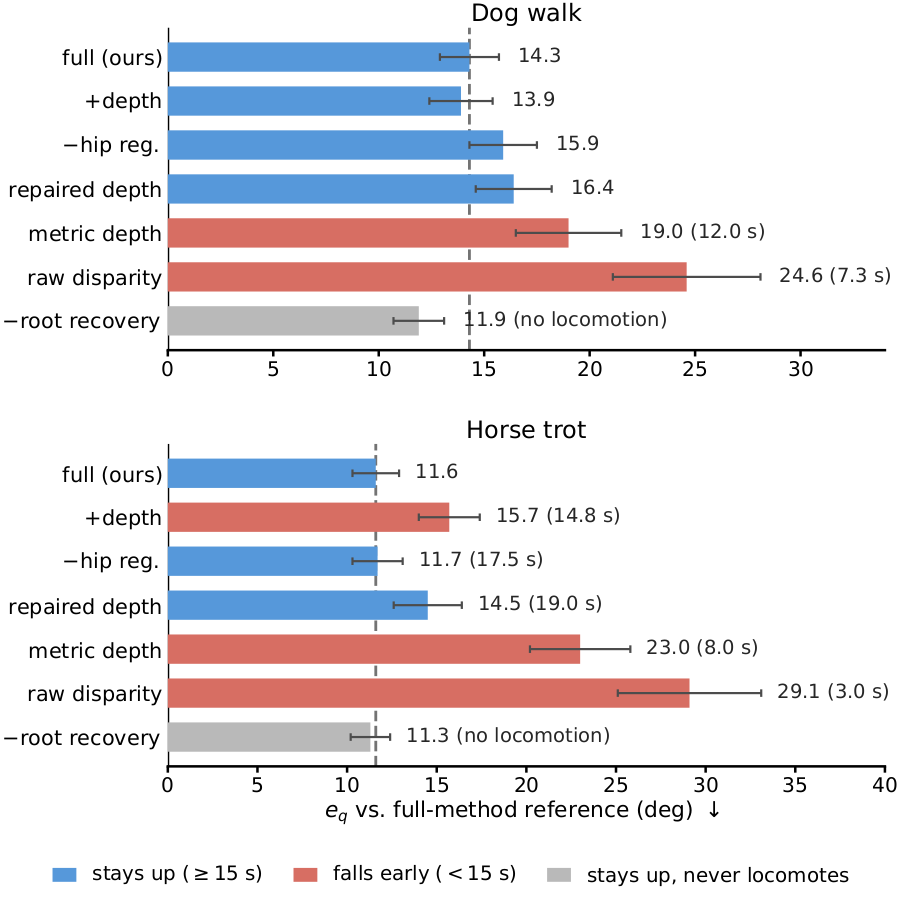
CopyQuad pins the lateral axis instead of estimating it, so the natural question is whether a depth model would do better. Swapping the pin for three levels of depth, raw disparity, metric depth, and metric depth repaired to feasibility, answers it: raw disparity puts the robot on the ground within seconds, metric depth survives longer but still falls, and even repaired depth, the closest analogue to what per-clip optimization buys in prior work, never beats the constant pin.
The rigidity test: can a depth model even hold a constant distance?
The left-right hip separation a depth model implies is a rigid distance that cannot move, so a faithful model should return it as nearly constant, with no training or ground truth required to check. Neither of two recent, widely used models does. A relative video depth model (VDA) varies the implied separation by 40–107% of its own mean on the dog clips, and returns almost no separation at all on the horse clips. A single-image metric model (Depth Pro) roughly halves that swing, but still varies by tens of percent, and on the trot it puts the left and right hip on the wrong side of each other in two frames out of five, barely above what a coin flip would give. On the dog walk that is about 2 cm of frame-to-frame drift on a quantity that cannot move, set against the 4.5 cm peak-to-peak of true paw travel the motion itself contains.
What video costs against motion capture
Motion capture gives the one setting where the discarded axis can be checked against ground truth. Two routes run on the same underlying dog-walk motion: one retargets the 3D markers directly, the other renders that motion to video and recovers a reference with CopyQuad alone, discarding the 3D entirely. Both share the same retargeter, reward and training budget.
| Route | eq (deg) ↓ | ep (cm) ↓ | Survival (s, cap 20) |
|---|---|---|---|
| MoCap route | 9.5±1.0 | 10.5±1.5 | 20.0 |
| Video route (CopyQuad) | 12.5±1.4 | 13.5±1.8 | 20.0 |
The two routes differ by 3.0° and 3.0 cm, and both survive the full episode. That gap is the price of video at this tracking bandwidth, measured on a rendered clip with no blur, occlusion or compression, so it's a lower bound on the cost of real footage. The number that settles whether the gap matters is simpler: the true peak-to-peak lateral paw excursion of this walk is 4.5 cm, with a mean deviation near 1.4 cm, against the 3.5 cm of lateral foot error the policies already leave. Perfect lateral tracking would remove at most 1.4 of those 3.5 cm, under a tenth of the total foot error, so the discarded axis sits below the pipeline's own resolution.
Limitations
The design is scoped to sagittally dominated motion under a roughly static camera, conditions two in five casually chosen clips fail to meet. It's bounded to symmetric gaits: a canter's lateral excursion is comparable to the lateral foot error itself, which is well outside the regime the pin is built for. And the rigidity argument covers per-pixel monocular depth specifically, not per-clip articulated 3D reconstruction, which does hold the rigid axis, just at the cost of a per-clip optimization that this pipeline is built to avoid.
BibTeX
@article{danesh2026copyquad,
  title={CopyQuad: Quadrupedal Skill Transfer from a Single Side-View Video Without a Depth Model},
  author={Danesh, Mohamad H and Hu, Raina and Xu, Mengxue and Lin, Hsiu-Chin},
  journal={arXiv preprint arXiv:2610.16737},
  year={2026}
}