



Abstract
A robot's morphology should be routed through learned dynamics, not fed straight to a policy. Dynamics within a morphological family change smoothly: stretch a limb or add some mass and the equations of motion shift continuously. But the best gait for that robot can change abruptly. A world model conditioned on $\mu$ can synthesize a coherent simulator for a robot it has never seen by interpolating in physical-feature space, and a policy trained against that simulator inherits the generalization for free. A policy that maps $\mu$ straight to actions has to learn a much rougher function instead, and it breaks.
Two ways to use a morphology spec
Take a robot's physical traits (limb lengths, mass distribution, actuator limits) and pack them into a morphology vector $\mu$. A controller for a whole family of robots can use that blueprint in two different ways.
μ → policy
μ, oₜ → π → aₜ
Feed μ straight to the policy and learn control directly. The policy has to approximate a function that can change sharply between nearby morphologies, which is a hard ask. It matches QWM on the training cohort, but degrades on unseen robots and collapses on the ones that are truly out of distribution.
μ → world model → policy in imagination
μ, oₜ → world model → π (in imagination)
Feed μ to a learned dynamics model instead, then recover the policy by training against it in imagination. The model only has to interpolate smooth physics, and the policy inherits that generalization for free, transferring zero-shot to robots that were never in the training set.
Our experiments hold $\mu$ identical between the two routes. On the training cohort they are indistinguishable, so any later gap is a generalization gap, not a capability gap. Only the model-based route crosses it.
How QWM works
QWM builds on DreamerV3 and changes three things so that a single model can serve a whole kinematic family.

Physical Morphology Encoder
robot description → μ ∈ [−1,1]¹⁰It reads four feature groups from the robot's description: kinematics & topology (limb lengths, knee configuration), geometry (stance footprint), dynamics (log-scaled mass, trunk fraction), and actuation (weight-normalized torque). Those get min-max normalized into $\mu \in [-1,1]^{10}$. A shallow tower keeps this static signal from getting washed out by the much noisier proprioception.
Morphology-conditioned dynamics
hₜ = f(hₜ₋₁, zₜ₋₁, aₜ₋₁, μ)zₜ ~ q(zₜ ∣ hₜ, eₜ)
$\mu$ goes into the recurrent state at every step, so the GRU is free to track dynamic state (velocity, contact timing) while the explicit conditioning carries the static physics (limb length, mass). The stochastic latent $z_t$ is then free to encode only the morphology-independent part of the dynamics.
Adaptive Reward Normalizer
σ_R ← EMA(P₉₅ − P₀₅)Spot earns ≈350 reward per episode; ANYmal-D ≈25. Without rescaling, big-reward robots dominate the world-model loss and it collapses to a mean-dynamics solution. A per-robot EMA of the 5–95 percentile return range equalizes the learning signal.
Results
Multi-morphology mastery & dynamics fidelity
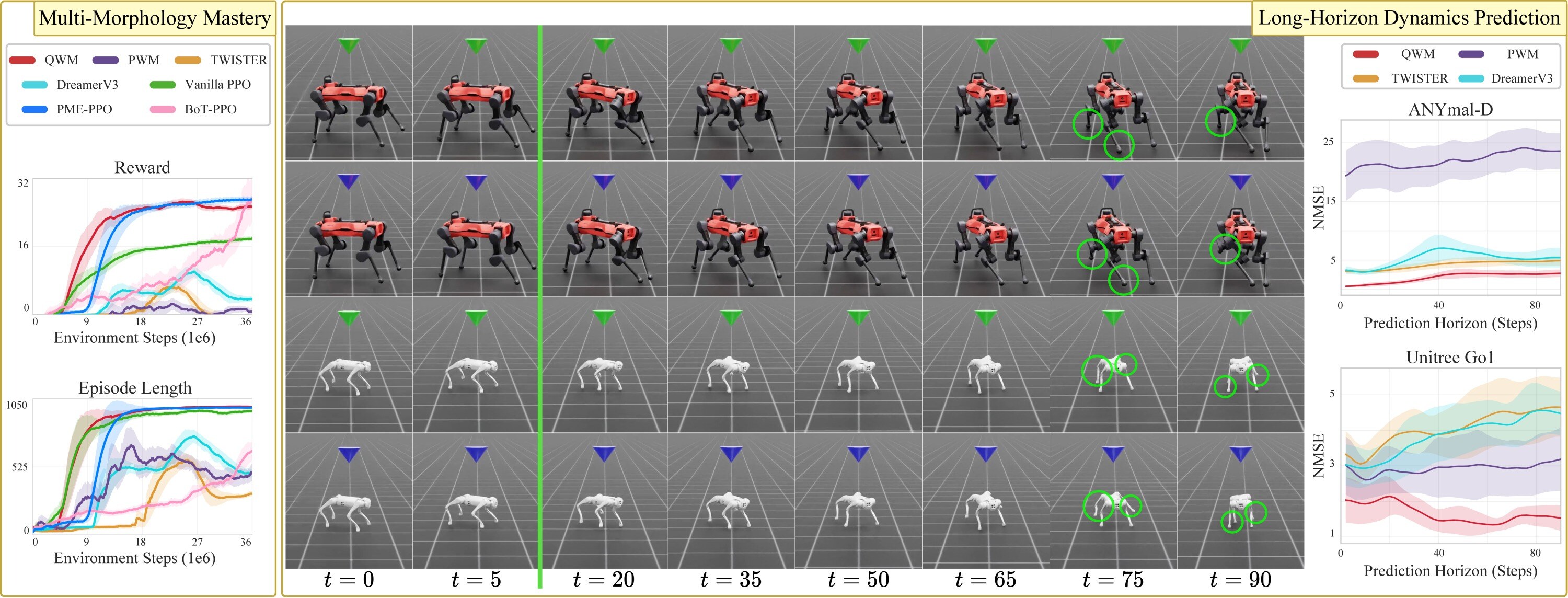
Given the same $\mu$, PME-PPO eventually catches up to QWM's reward. But QWM gets there in about half the environment steps, and it leaves behind a reusable dynamics model as a bonus. On the training cohort, the two routes are basically tied on capability, which is exactly what makes the generalization comparison below a fair one.
Zero-shot transfer to unseen morphologies
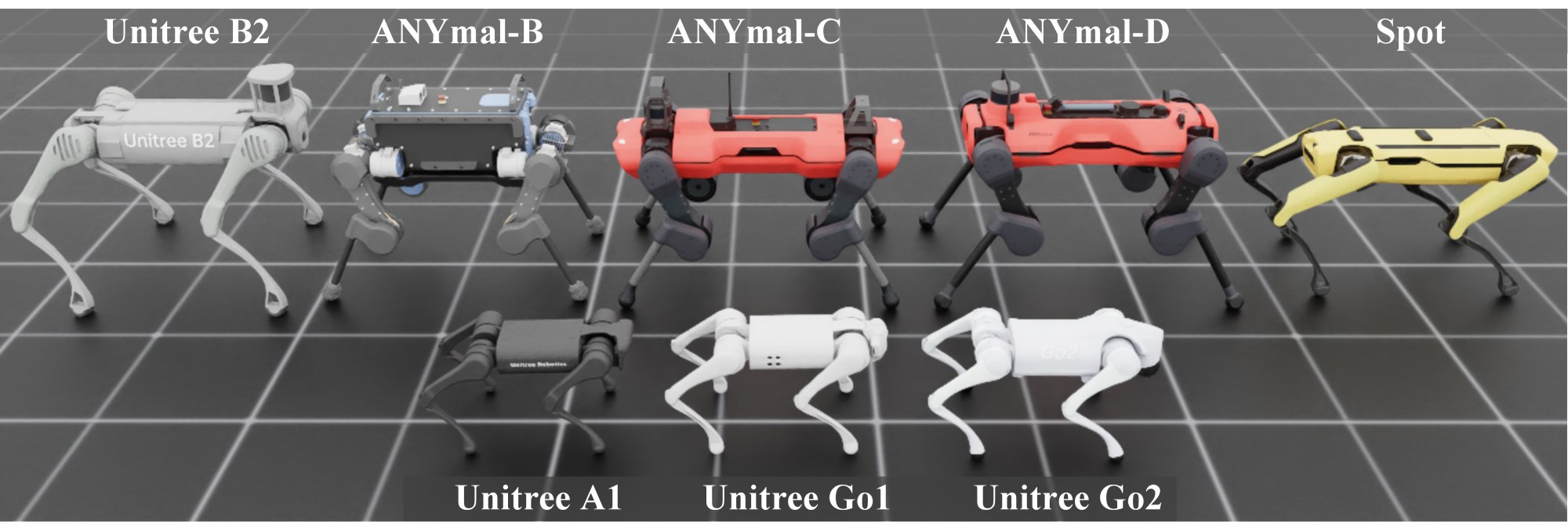
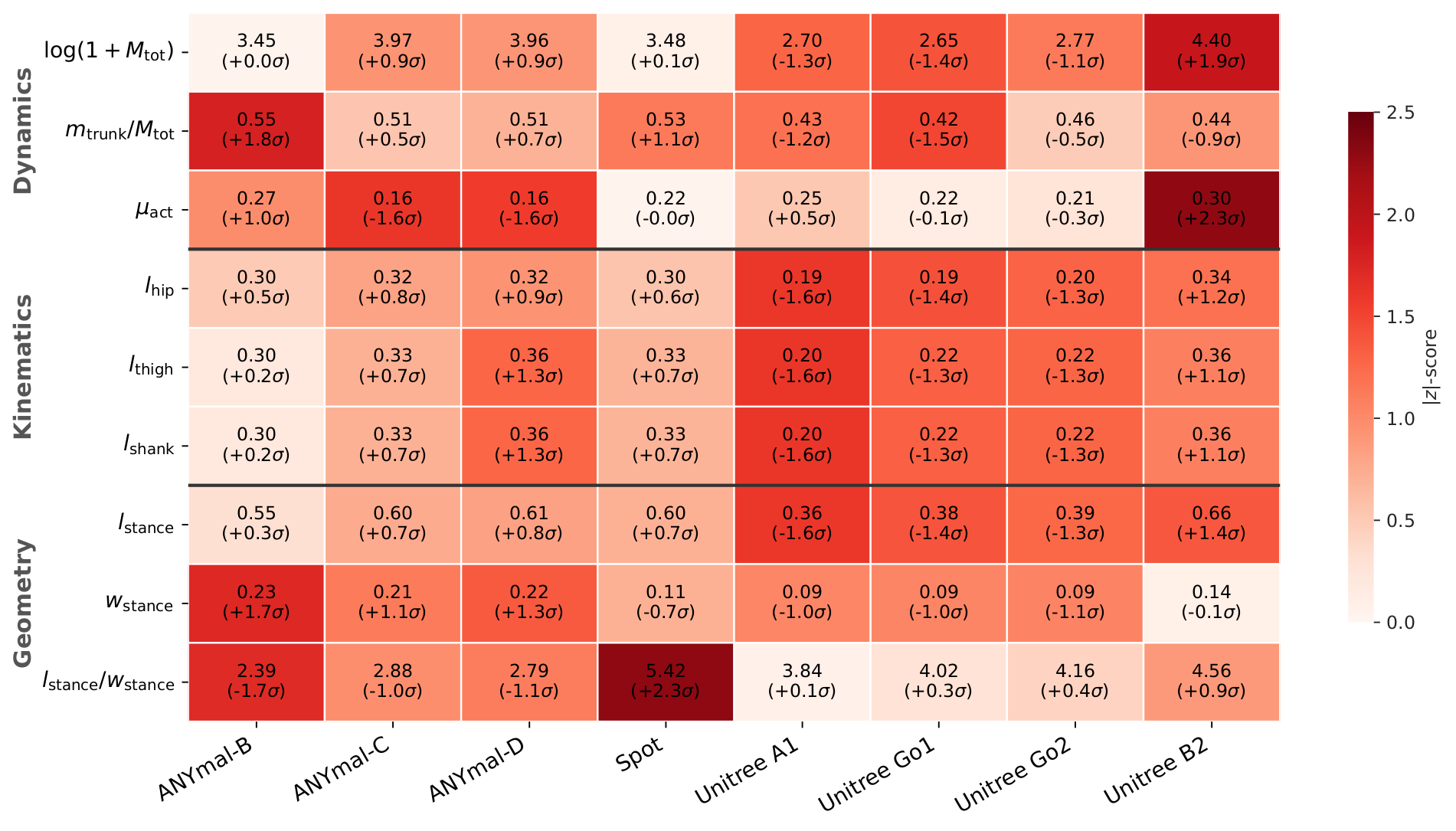
To test a target robot, we train from scratch on the other seven, then run the frozen model and policy on the target using only its $\mu$. Go1 and ANYmal-D both sit inside the cohort's normal range. B2 doesn't: it's heavier, stronger, and has a longer stance, all at the same time. Each of those traits is mild on its own, but no training robot combines all three, which makes B2 a genuine combinatorial gap.
| Method | ANYmal-D (in-range) | Unitree Go1 (in-range) | Unitree B2 (combinatorial gap) | |||
|---|---|---|---|---|---|---|
| Reward | Ep. length | Reward | Ep. length | Reward | Ep. length | |
| PME-PPO (same $\mu$, model-free) | 10.1 | 530 | 23.1 | 602 | −0.2 | 337 |
| QWM (zero-shot) | 18.2 | 949 | 35.5 | 974 | 12.1 | 925 |
| Specialist PPO (oracle, trained on target) | 21.8 | 981 | 39.7 | 996 | 13.6 | 961 |
PME-PPO reads the exact same $\mu$ but still trails by 350–600 steps of episode length, and it collapses completely on B2. QWM stays within about 4% of specialist episode length and recovers 80–90% of specialist reward on the in-range robots, and it still walks B2 zero-shot at close to specialist episode length.
Per-feature morphology deviation: why B2 is the hard case
Real-world deployment
The frozen zero-shot ANYmal-D and Go1 policies run straight on hardware: the exact simulation weights, 50 Hz inference on each robot's own onboard computer, and no real-world fine-tuning at all. QWM settles into a quick trot on the agile Go1 and a slower, more grounded gait on the heavier ANYmal-D.
| Platform | Method | $e_{xy}$ (m/s) ↓ | $e_{yaw}$ (rad/s) ↓ |
|---|---|---|---|
| ANYmal-D | QWM (zero-shot) | 0.30 | 0.29 |
| ANYmal-D | Specialist PPO | 0.28 | 0.26 |
| Unitree Go1 | QWM (zero-shot) | 0.34 | 0.34 |
| Unitree Go1 | Specialist PPO | 0.31 | 0.30 |
Zero falls across all 20 trials (10 per platform × 60 s), with velocity-tracking error within ~10–13% of a specialist controller trained only on that robot.
Why the model-based route wins
Because $\mu$ is handed straight to the recurrent state $h_t$, the stochastic latent $z_t$ never has to re-infer the robot's physical identity. It only has to encode dynamic state. Probing backs this up: $h_t$ splits cleanly into per-robot clusters, while $z_t$ collapses into one shared, morphology-agnostic cloud (silhouette score 0.033).
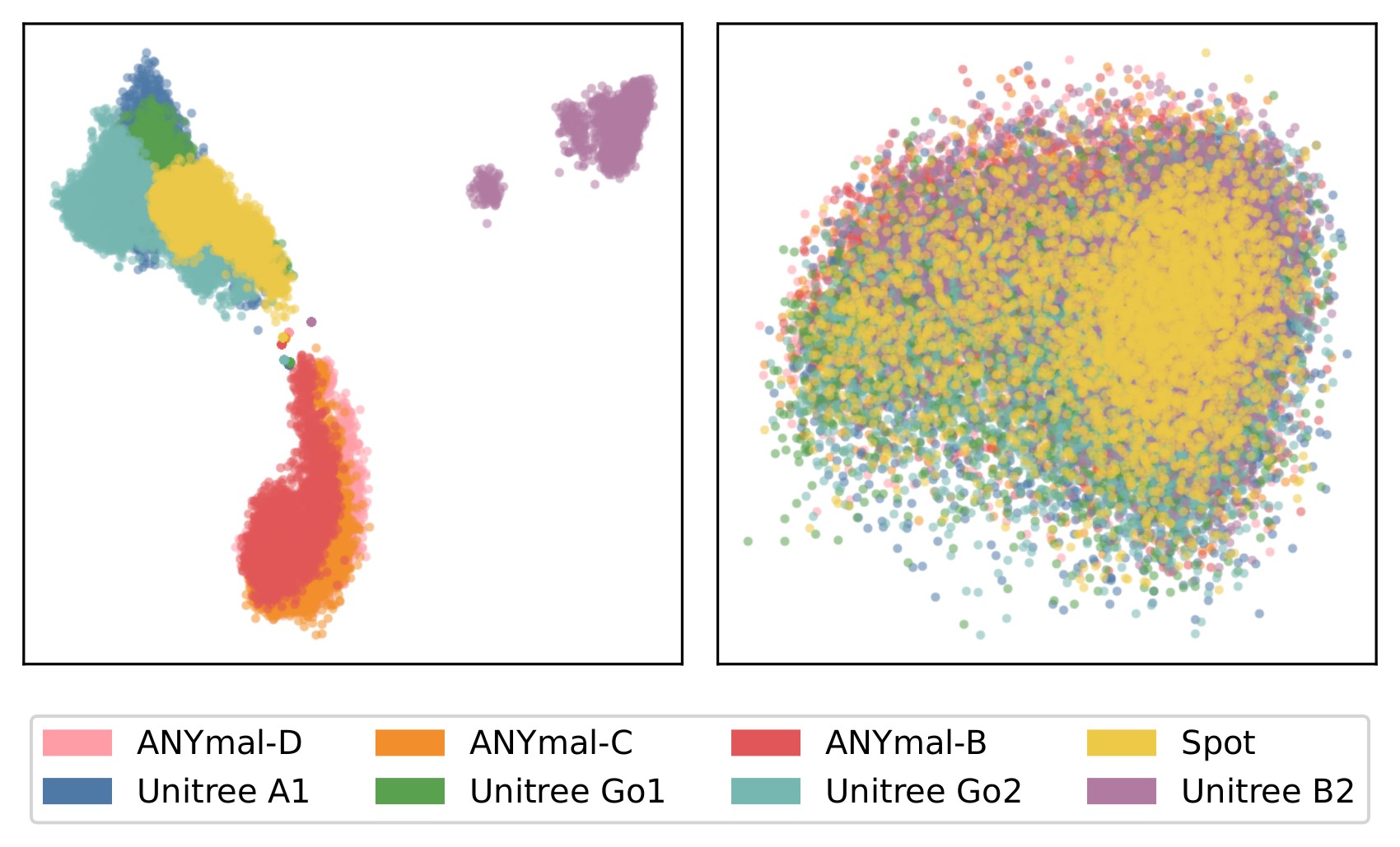
That decoupling gives QWM a correction channel that a spec-sheet policy simply doesn't have. Corrupt $\mu$ by 20% and QWM still keeps about 80% of its episode length, while PME-PPO drops to roughly 33%, because $z_t$ keeps reading the true dynamics from observations. Now flip it around: keep $\mu$ correct but degrade the real robot with 20% torque loss or an added payload. Even a near-exact analytical rigid-body predictor diverges here, while QWM stays within 75 to 84% of its normal episode length.
Ablations
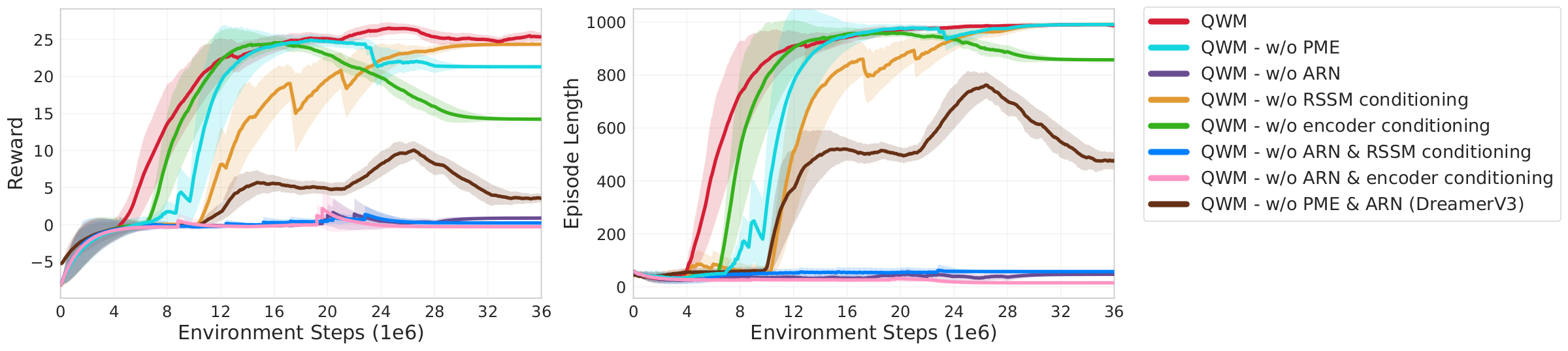
Limitations
$\mu$ encodes a fixed quadrupedal template: three-segment legs, a 12-DoF action space, and a hip-rooted stance. So generalization is parametric within that template, not across structural variants like a different number of joints per leg or a non-quadrupedal body. Evaluation is also limited to blind, flat-ground velocity tracking, without exteroception or contact-rich terrain.
BibTeX
@inproceedings{
anonymous2026morphologyconditioned,
title={Morphology-Conditioned World Model for Cross-Embodiment Quadrupedal Locomotion},
author={Anonymous},
booktitle={10th Annual Conference on Robot Learning},
year={2026},
url={https://openreview.net/forum?id=YQoaLlpDD3}
}