Toward Hardware-Agnostic Quadrupedal World Models via Morphology Conditioning

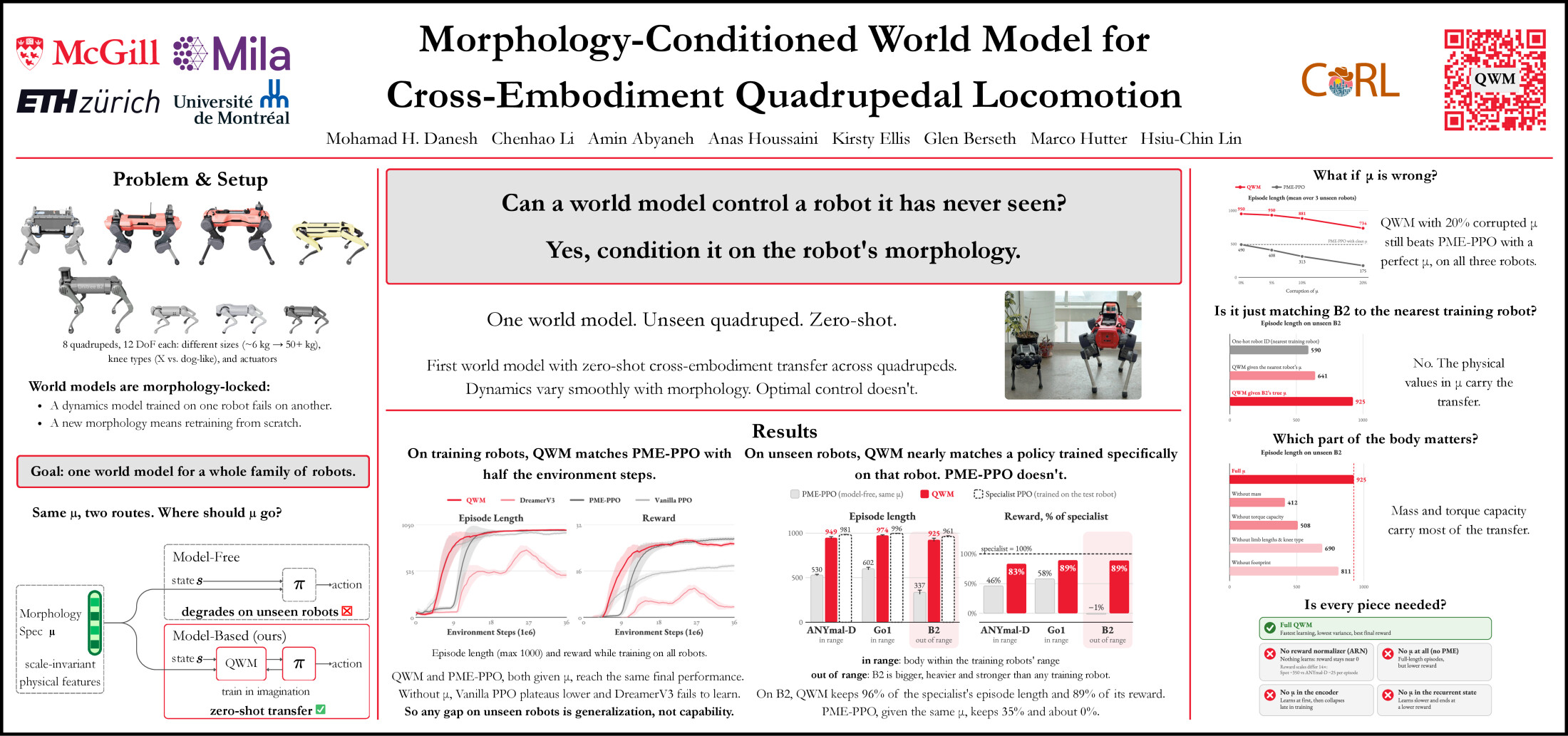
Toward Hardware-Agnostic Quadrupedal World Models via Morphology Conditioning arXiv 2026 Mohamad H. Danesh  ·  Chenhao Li  ·  Amin Abyaneh  ·  Anas Houssaini Kirsty Ellis  ·  Glen Berseth  ·  Marco Hutter  ·  Hsiu-Chin Lin McGill University  ·  ETH Zürich  ·  Université de Montréal / Mila arXiv PDF Code (coming soon) Abstract World models trained on one quadrupedal platform typically fail on different hardware due to morphological differences in mass, link dimensions, and kinematic configuration. We present QWM, a framework that enables a single neural dynamics model to generalize across diverse quadrupedal robots without retraining. The key innovation is to explicitly condition the generative dynamics on the robot's engineering specifications — extracted directly from URDF/USD files — rather than inferring physical properties implicitly from interaction history. A Physical Morphology Encoder (PME) derives a compact embedding from kinematic, geometric, dynamic, and actuation features, which is injected into every recurrent step of a DreamerV3-based world model. An Adaptive Reward Normalizer (ARN) handles heterogeneous reward scales across platforms. We further introduce Hetero-Isaac, an extension to NVIDIA Isaac Lab enabling true heterogeneous training across different morphologies in parallel. QWM achieves zero-shot locomotion on unseen robots — including real-world deployment on Unitree Go1 and ANYmal-D — with performance approaching per-robot specialists, while eliminating the dangerous adaptation lag of implicit system identification approaches. ...